Rimowa's parallel grooves, a distinctive three-dimensional striped pattern, have been an iconic part of its luggage products since the 1950's. This groove design is now widely recognized by consumers worldwide as representing the quintessential "Rimowa style." Over the years, this design has been emulated on various products such as pouches, and cases for cigarettes and for electronic devices. Some of these imitations have even been registered as designs in Korea.
To curb such practices, Rimowa sought to invalidate two design registrations of a Korean individual for earphone cases that featured its groove design, on the basis that they lacked creativity. The Intellectual Property Trial and Appeal Board agreed with Rimowa that these designs could have been easily created from Rimowa's prior luggage design and invalidated them.
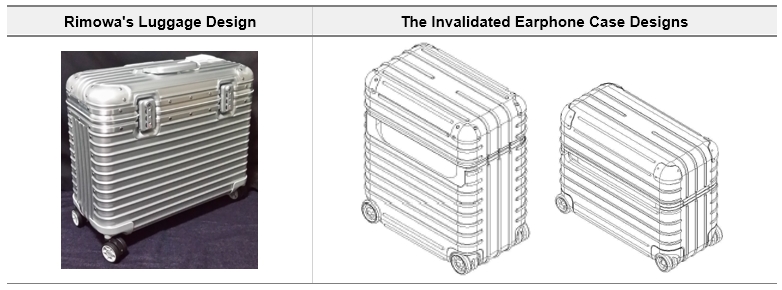
The registrant, however, appealed both cases to the IP High Court, arguing that no designer could easily devise an earphone case from a suitcase because the two products differ significantly in size, structure, and function.
Rimowa refuted these arguments by demonstrating that the products are visually and also functionally similar in that they both have protective and portability purposes and comparable structures. It also demonstrated that designers frequently adapt luggage aesthetics to small products by providing many marketplace examples of small accessories copying Rimowa's design that are referred to by both consumers and sellers as "Rimowa-style cases." Rimowa also provided evidence that the differences cited by the registrant merely reflected the modifications that are inevitably made when translating a large suitcase design into a small accessory.
The IP High Court accepted all of Rimowa's arguments and affirmed the invalidation decisions, holding that a designer could easily create the earphone case designs by applying Rimowa's well-known groove design. The court further clarified that, in assessing the creativeness of a design, the products do not have to be identical or even similar; rather, similarity in function or structure, and design trends across product categories may be just as relevant.
These cases are significant because they confirm that a brand's core design identity, such as Rimowa's groove pattern, can be protected across product categories. They will serve as useful precedents for rights holders whose signature designs are imitated by small accessories manufacturers, a trend which appears to be on the rise.
The matters also hold procedural significance. These were the first international trials conducted in Korea where participation in the court hearings by a representive of an overseas litigant was facilitated by making the hearings accessible by video conference. Rimowa's representative in Germany was invited by the court to attend remotely and he presented the closing arguments. This marks a meaningful step in the Korean judiciary's accommodation of international IP disputes.
Related Topics
#Design #IP High Court case #Invalidation #2025 Issue 4 #2026 Issue 1