The Supreme Court recently rendered a decision on February 26, 2026 which highlighted the valuable interplay between design and trademark protections. The ruling confirms that the shape of a product can function as a source identifier, and that a party is not precluded from securing a 3D trademark registration simply because they already hold a design registration for that same shape, provided the shape is recognized by consumers as an indication of source.
The petitioner, Woosung IB, a manufacturer of towable water tube products, filed a scope confirmation trial against a competitor, Aqua Festa. Woosung IB argued that since the shape of its tube was recognized as a well-known source identifier, having been registered as a 3D trademark, Aqua Festa’s use of the same shape for its towable tube product fell within the scope of Woosung IB’s registered trademark rights. Conversely, Aqua Festa argued that its use of the shape was purely decorative and that its distinctive word mark (“Aqua Festa”) served as the source identifier.
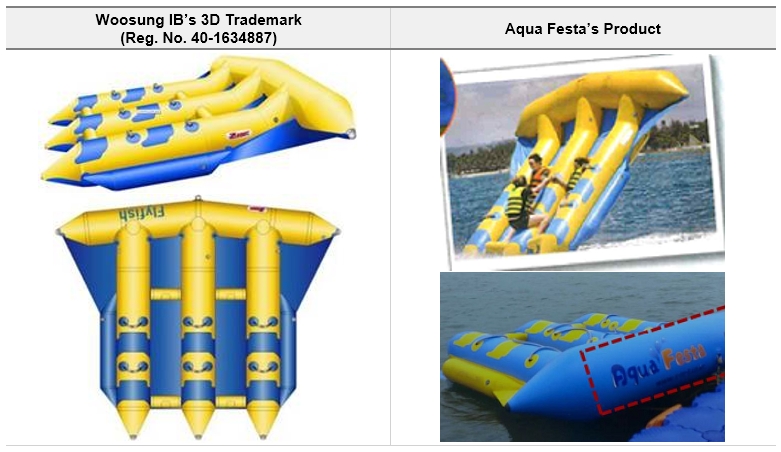
The IP High Court agreed that the shape of Aqua Festa’s product was merely a decorative design element, noting that consumers generally perceive the appearance of water leisure equipment as aesthetic rather than as a brand indicator. The court reasoned that the word mark would have been perceived as the source identifier and concluded that the use of the same tube shape by Aqua Festa did not fall within the scope of protection of Woosung IB’s 3D trademark registration.
The Supreme Court reversed this decision, confirming that Woosung IB’s tube shape functions as a source identifier. Firstly, the court noted that only Woosung IB had used this specific tube shape for over 20 years. It had owned a design registration for an almost identical shape for approximately 15 of those years, and no one else had sold a similar shaped tube either before or after Woosung IB’s design application was filed. Second, the court pointed to consumer recognition; given the distinctive shape and extensive advertising in newspapers and magazines, it was reasonable to conclude the shape was well-known to consumers as a source indicator of Woosung IB. The court also found that Aqua Festa had intended to “free-ride” on Woosung IB’s fame by using a shape that imitated Woosung IB’s.
The Supreme Court’s decision highlights that design registrations and 3D trademark registrations can not only co-exist, owning a design registration can help a shape acquire the distinctiveness necessary to function as a trademark. It is also notable that the court held that Aqua Festa’s use fell within the scope of Woosung IB’s 3D trademark registration despite the differences between ‘AQUA FESTA’ and the ‘FLYFISH’ word component of Woosung IB’s registration.
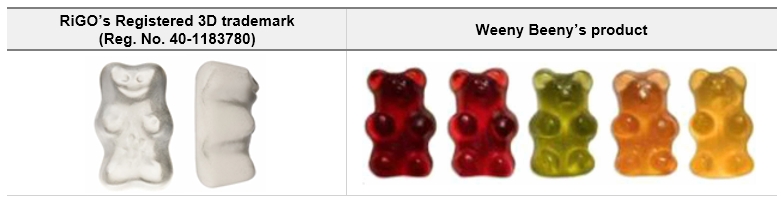
There have been similar cases where the main issue was whether a 3D shape functions as a trademark or merely as a design. In a scope confirmation trial, the IP High Court rendered a decision on February 14, 2025 holding that the shape of a gummy did not function as a source identifier. RiGO Trading S.A.(“RiGO”), the manufacturer of gummy bears under the name “Haribo,” had registered a 3D trademark for the shape of the Haribo gummy in 2016 by proving secondary meaning of the shape. RiGO sent a warning letter to Weeny Beeny in 2022, arguing that Weeny Beeny’s gummy product has a similar shape and that their sales fell within the scope of RiGO’s 3D trademark. Thereafter, Weeny Beeny filed a negative scope confirmation trial, asserting that Weeny Beeny’s sales of their gummy does not fall within the scope of RiGO’s 3D trademark. The IP High Court held that the bear shape used by Weeny Beeny functioned only as a product design, not as a source identifier. The court pointed to the fact that Weeny Beeny sold the bear shaped gummy with many other different shaped gummies, such as cola bottles, worms, fruits, and hearts, in a “Pick & Mix” manner, and multiple brands offered gummy products in different bear shapes. The court also highlighted that RiGO used the word mark “HARIBO” very prominently on the packaging of every one of its jelly products, which lowered the likelihood that its gummy shape was perceived by consumers as RiGO’s trademark. In addition, the court identified visual differences between the compared gummies in terms of the contours, facial features, and overall proportions, while noting the long-standing presence of similar bear-shaped gummies in the Korean market.
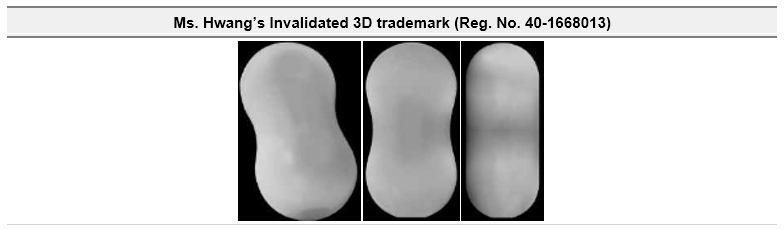
Further, in May 29, 2025, the IP High Court invalidated a registration for 3D trademark for crayons, ruling that the shape was a common design rather than a source identifier. Ms. Hwang, the representative of a company named Ddangkong Press, registered a 3D trademark for a crayon. The petitioner, a company named Morning Glory, filed an invalidation action against Ms. Hwang’s 3D trademark, arguing that it lacked distinctiveness and could not function as a trademark since it was merely the shape of a crayon. The IP High Court found that crayons are generally produced by a casting method in which a mixture of pigments and oil-based wax is melted, poured into a mold, and solidified; due to this manufacturing method, crayons in a variety of diverse shapes exist. Considering the diverse shapes of crayons, Ms. Hwang’s 3D trademark can be viewed as falling within the scope of what can be adopted for crayons in the marketplace, and it was determined that consumers are highly likely to perceive this 3D trademark as a design rather than as an indication of source. The court also emphasized that because Ms. Hwang’s product was marketed for its functional benefits, such as being easy for children to grip, consumers were more likely to view the shape as a useful feature rather than a trademark.
The Supreme Court dismissed the appeals against both of the above two cases without examining the merits.
It is important to note that in cases where similar 3D shapes had become common in the marketplace, where a word mark had been prominently used on the products, or where the trademark owner’s product had been promoted for its functional advantages (for example, being easy to grip), courts have tended to find that the 3D shape at issue functioned as a product design rather than a source identifier. In those cases, the 3D trademark registration involved was invalidated (in invalidation actions) or its scope of protection became narrower as a result. By contrast, if a 3D trademark owner can demonstrate exclusive use of its shape over a long period of time, courts appear more willing to recognize it as a trademark, even if the brand owner also uses a word mark on its product.
Accordingly, for companies with iconic or highly distinctive product designs, it is crucial to vigilantly monitor and enforce their 3D trademarks against competitors using similar 3D shapes. It is also advisable to refrain from putting too much emphasis on functional features of the shape when advertising the product. Further, since 3D shapes are protectable under both 3D trademark and design registrations, we recommend additionally securing a 3D trademark registration for the shape if it also functions as a source identifier. This is because while design rights provide robust protection for a fixed term, a 3D trademark can be renewed indefinitely and the proprietary rights in the product’s signature shape can be protected long after the design registration expires.
Related Topics